Ascending Peptides: between the hormone pulses
CJC-1295 raised the level between bursts while the bursts continued. The intervals absorbed me.

CJC-1295, one week later
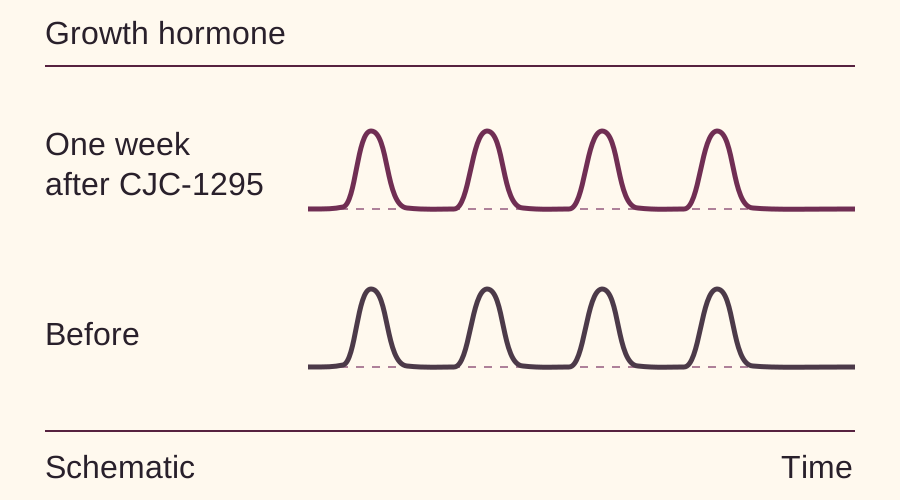
In my mental sketch, a lasting stimulus smoothed away the bursts. In a small 2006 study of healthy men aged 20–40, growth-hormone pulses continued after CJC-1295. One week after a single administration, neither their frequency nor their magnitude had changed significantly. The level between pulses, however, had risen approximately 7.5-fold; mean growth hormone rose by about 46% and insulin-like growth factor 1 by about 45%.
That is a more interesting ascent than a taller peak. The low part of the curve moved. A hormone result can change substantially while the familiar rhythm survives, and my attention shifted toward those intervals.
Growth hormone comes from the pituitary gland below the brain. It encourages the liver to produce insulin-like growth factor 1, usually shortened to IGF-1. Here, both readings rose, but the experiment was designed around hormone secretion. Better sleep, greater strength and faster recovery remained questions for other experiments.
Duration and rhythm
The other early CJC-1295 paper supplies the time dimension: in healthy adults, growth hormone remained elevated for six days or more, and IGF-1 for nine through eleven days. The long-acting form attaches to albumin, a circulating blood protein, which helps explain its persistence. Those findings concern CJC-1295 with DAC, the albumin-binding modification; the short-acting no-DAC form has a different duration.
I admire albumin binding as an answer to a fleeting signal. My enthusiasm ends before the leap from a longer hormone response to a longer or healthier life. The published measurements support a striking pharmacological effect, with large gaps around lasting human benefit and safety.
Bowel recovery and abdominal fat
Ipamorelin approaches growth-hormone release through the receptor for ghrelin, the hormone involved in hunger. Its human history includes a very practical question: could people eat sooner after bowel surgery? The trial in 114 adults missed that primary endpoint.
Tesamorelin has a different record. In adults with HIV and abdominal fat accumulation, trials measured reductions in visceral fat and liver fat. Visceral fat is the fat around internal abdominal organs. Its US approval covers excess abdominal fat in adults with HIV-associated lipodystrophy, a condition involving abnormal fat distribution.
I stay interested because these responses diverge. Related hormone responses lead into studies of meals, fat and blood proteins, each with its own answer. A single upward arrow would erase most of the story.
Continue with a compound
- CJC-1295 and albumin: the long stay in blood, continued pulses and a changed protein profile.
- Ipamorelin’s meal trial: the move from a brief hormone response to a test of recovery after surgery.
- Tesamorelin’s fat results: measured tissue changes, a narrow approved use and the return of fat after treatment ended.
The comparison sets those human experiments beside one another. CJC-1295 and ipamorelin have no approved medical indication; tesamorelin’s approval remains limited to its specified HIV-associated fat condition. None of these pages supplies a personal treatment plan.